Stargazing
Binoculars for stargazing: what to buy and what you can see
Why 10x50 is the classic stargazing size, what binoculars show of the Moon, Jupiter, the Pleiades and Andromeda, and how to hold the view steady.
You do not need a telescope to start exploring the night sky. A pair of binoculars shows craters on the Moon, star clusters, the band of the Milky Way and, from a dark site, the light of another galaxy. Binoculars use both eyes, show a wide patch of sky so you can find your way, and set up in seconds. NASA calls binoculars a great first telescope for exactly these reasons.
This guide explains which sizes work best, what you can realistically expect to see from the UK, and how to get a steady view.
Why 10x50 is the classic size
NASA recommends a good pair of binoculars ranging in specifications from 7x35 to 10x50, and suggests not getting anything much more powerful than 10x50 at first. There are two reasons.
Light. At night the pupil of your eye opens to roughly 7 mm. Binoculars with a large exit pupil (the objective size divided by the magnification) send a beam wide enough to fill it. A 10x50 has a 5 mm exit pupil, a 7x50 has 7.1 mm. A compact 10x25 has only 2.5 mm, which wastes much of what a dark-adapted eye can take in. Studies of pupil size show that the dark-adapted pupil tends to be smaller in older people, so a 5 mm exit pupil suits most adults well.
Steadiness. Stars are points of light, and any shake turns them into little squiggles. NASA notes that higher-power binoculars are more difficult to hold steadily and jiggle unless you use image stabilisation or a tripod. At 10x most people can hold a usable view, especially when seated.
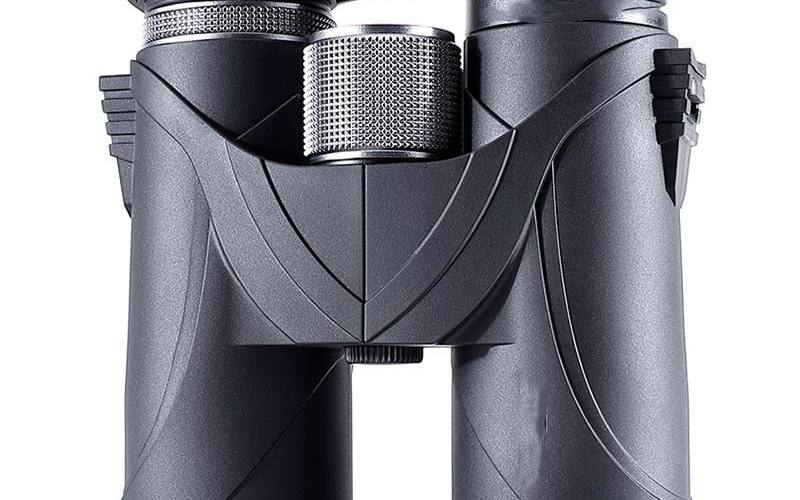
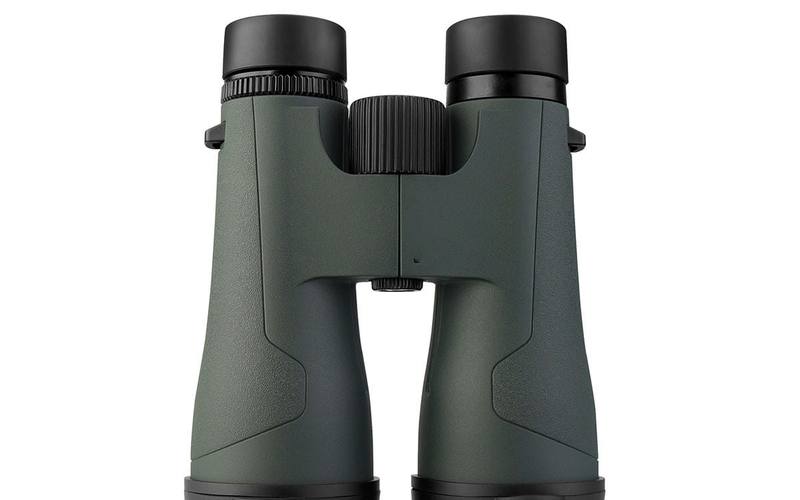
Our 10x50 porro binoculars are built around exactly this size. The 12x50 waterproof binoculars show more on a tripod, using the adapter thread between the lenses.
What you can see
These targets are realistic with 8x42 to 12x50 binoculars from the UK. NASA lists the Moon, large open star clusters like the Pleiades, Jupiter's moons and, from dark skies, the Andromeda Galaxy.
The Moon
The best first target, and good on any clear night. Look along the terminator, the line between the lit and the dark part, where the low sunlight throws long shadows and craters stand out. A half Moon is far more interesting than a full Moon, which looks flat.
The Pleiades
The Seven Sisters in Taurus are an open star cluster high in the winter sky. With the naked eye you see six or seven stars. Binoculars show a few dozen, and the whole cluster fits easily into the field.
Jupiter and its moons
Jupiter appears as a bright, steady disc-like point. Hold the binoculars steady, ideally on a tripod, and you may spot its four largest moons, Io, Europa, Ganymede and Callisto, as tiny stars lined up on either side. Look again the next night and they will have moved.
The Andromeda Galaxy
From a dark site in autumn and winter, Andromeda shows as an elongated, faint misty patch in the constellation of the same name. It is around 2.5 million light years away and the most distant thing most people will ever see with their own eyes.
The Milky Way and star clusters
Sweep slowly along the Milky Way through Cygnus in late summer and Cassiopeia and Perseus in autumn. Binoculars split the glow into countless stars. The Double Cluster between Perseus and Cassiopeia and the misty glow in the sword of Orion in winter are lovely binocular sights.
Wide-field binoculars for whole constellations
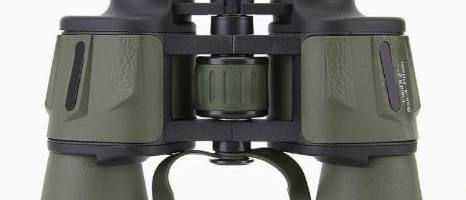
Ordinary binoculars show around 5 to 7 degrees of sky. Constellation binoculars take the opposite approach: very low magnification and a very wide view. Our 3x50 stargazing binoculars are marked with a 17 degree field, enough to take in whole constellations such as Orion or Cassiopeia at once, with noticeably more stars than your eyes show alone.
An honest note on brightness: a 3x50 has an exit pupil of 50 / 3 = 16.7 mm, much wider than any eye pupil, so your eye only uses the central part of the light. What you gain is the field of view and a view so steady you never need a tripod. They complement a 10x50 rather than replace it.
How to get a steady view
- Sit down. A garden chair with armrests, or better a reclining sun lounger, lets you look up without straining your neck and gives your elbows support.
- Brace your arms. Tuck your elbows into your chest or rest them on the armrests or your knees.
- Use a tripod for 12x and above. Binoculars with a tripod adapter thread, like our 12x50, can be fitted to a standard photo tripod with a binocular adapter.
- Lean on something if you are standing: a wall, a fence or a car roof.
Dark skies and dark adaptation
Light pollution washes out faint objects. Get away from street lights if you can, even if only to the dark side of your house. The UK has several officially recognised dark sky places, including Galloway Forest Park, Exmoor National Park and Northumberland, where the Milky Way is easy to see on a clear moonless night.
Your eyes need time to adapt to the dark: give them at least 20 minutes, and protect that adaptation by using a red torch or the red night mode of a star chart app. A planisphere, a rotating paper star chart, works without a battery.
Dew and cold
On clear nights dew forms on everything, including the front lenses. Keep the lens caps on between looks and point the binoculars down when you are not using them. When you bring cold binoculars back into a warm house, condensation forms on the glass. Leave them in their bag to warm up slowly, then let them dry naturally with the caps off. More in Looking after binoculars in wet weather.
Safety: never the Sun
Never point binoculars at the Sun, not even for a moment and not near sunset. The lenses concentrate its light and can permanently damage your eyes. Teach children the same rule, and put the caps on when binoculars are left outside in daylight.
Which of our binoculars for the night sky
- 10x50 porro binoculars: the classic first pair, 5 mm exit pupil.
- 12x50 waterproof binoculars: more magnification, best on a tripod, IPX7 rated for dewy nights.
- 3x50 stargazing binoculars: whole constellations and star fields with a 17 degree field.
Not sure what the figures mean? Start with What the numbers on binoculars mean.
Frequently asked questions
What are the best binoculars for stargazing?
For a first pair, NASA suggests binoculars between 7x35 and 10x50 and advises against anything much more powerful than 10x50 at first. 10x50 is the classic choice: a 5 mm exit pupil for faint objects and a magnification you can still hold by hand.
Can you see planets with binoculars?
You can see Jupiter, Saturn, Mars and Venus as bright points, and from a steady position you may spot Jupiter's four largest moons as tiny stars in a line. You will not see detail such as Saturn's rings clearly; that needs a telescope.
Do I need a tripod for stargazing with binoculars?
Not at 7x to 10x, if you brace your elbows or lean back in a chair. At 12x and above, a tripod with a binocular adapter shows noticeably more because the stars stop dancing.
Is it safe to look at the Moon through binoculars?
Yes. The Moon is bright but safe to look at. Never point binoculars at the Sun, not even briefly or near sunset, as it can cause permanent eye damage.
What are constellation binoculars?
Very low power binoculars, typically 2x to 3x, with a huge field of view. Ours are 3x50 with a 17 degree field. They show whole constellations with more stars than your eyes alone, rather than enlarging single objects.