How-to
How to use and focus binoculars, step by step
How to set up and focus binoculars: eye spacing, centre focus, the dioptre and eyecups, then how to find a bird fast, hold the view steady and clean the lenses.
New binoculars often disappoint on the first walk, not because they are poor but because they have not been set up for the person using them. Two minutes with the hinge, the focus wheel and the dioptre make a bigger difference to the view than most upgrades. This guide shows how to set up any pair of centre-focus binoculars, then how to find a bird quickly, hold the view steady and keep the lenses clean.
Know the controls
Most modern binoculars have the same four controls:
| Control | Where it is | What it does |
|---|---|---|
| Hinge | the bridge between the barrels | sets the distance between the eyepieces to match your eyes |
| Centre focus wheel | between the barrels | focuses both sides at once |
| Dioptre ring | usually on the right eyepiece, on some models the left | corrects the difference between your two eyes |
| Eyecups | on each eyepiece | set how far your eye sits from the lens |
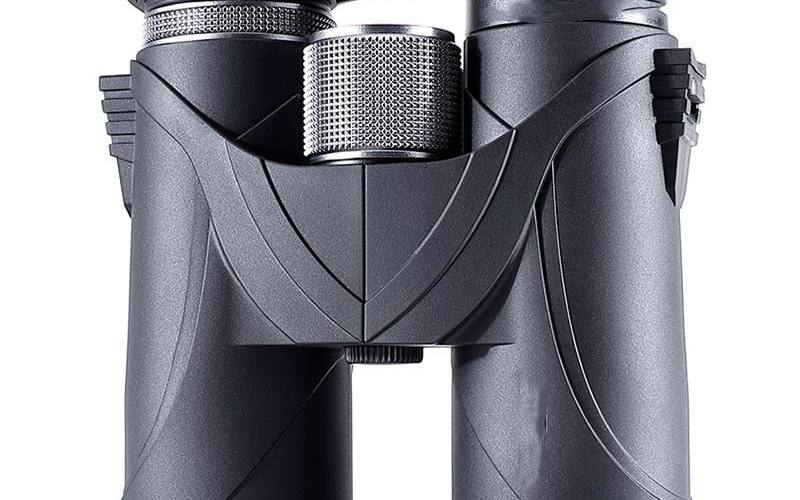
Our 10x50 porro prism binoculars and 12x50 waterproof binoculars both have the dioptre on the right eyepiece. Check your manual, because the steps below change slightly if yours is on the left.
Step 1: set the eyecups
If you wear glasses while looking through binoculars, twist or fold the eyecups down. If you do not, twist them up. That is Nikon's advice, and it is the same in Opticron's manuals. Our guide to binoculars for glasses wearers explains why.
Step 2: set the eye spacing
The distance between the centres of your pupils is called the interpupillary distance. A study of adult measurements put the average at about 63 mm, with most adults between about 50 and 75 mm. Binoculars have a hinge so they can match it. The 12x50, for example, adjusts from 61 to 74 mm.
Hold the binoculars to your eyes and look at something in the distance. Fold the barrels together or apart until, in Nikon's words, both fields form a single circle. If you see two overlapping circles, keep adjusting. If you see a circle with black edges at the sides, the barrels are too far apart.
Note the number on the hinge scale if there is one, so you can set it again quickly.
Step 3: focus for your left eye
Pick a detailed object about 20 to 30 m away, such as a sign, a brick wall or a branch. Nikon suggests covering the right lens with your hand rather than squinting, so both eyes stay relaxed.
With the right side covered, turn the centre focus wheel until the object is as sharp as you can get it for your left eye. Go slightly past sharp and come back, so you find the best point.
Step 4: set the dioptre for your right eye
Now cover the left lens and look with your right eye. Do not touch the centre wheel. Instead, turn the dioptre ring on the right eyepiece until the same object is sharp.
That is it: both sides are now matched to your eyes. Nikon suggests marking the dioptre setting so it does not move. A small dot of nail varnish or a note of the number on the scale works well.
If the dioptre is on the left eyepiece, do it the other way round: focus the right eye first with the centre wheel, then set the left eye with the dioptre. Opticron's instructions for some of its models do exactly this.
Step 5: from now on, use only the centre wheel
Once the dioptre is set, leave it alone. Every time the distance changes, focus with the centre wheel only. If someone else borrows your binoculars, they will need to change the hinge and the dioptre, so note your settings before you hand them over.
Step 6: adjust the strap
Shorten the strap so the binoculars hang high on your chest, not on your stomach. They come up to your eyes faster, swing less as you walk and are less likely to knock against a gate or a fence.
Finding a bird quickly
It is common to spot a bird, raise the binoculars and see only leaves. Nikon's tip is to spot the bird with your eyes and keep your gaze fixed on it, then bring the binoculars up to your eyes without looking away. Practise on a still object until it becomes automatic.
When a bird is in a large tree or a hedge, use landmarks. Nikon suggests using a tree or a branch as a reference point to find the bird again. Note something distinctive near it, such as a fork in a branch or a patch of ivy, find that first, then move to the bird.
Holding the view steady
- Tuck your elbows in against your chest.
- Lean on something: a gate, a wall, a tree or a hide window.
- Breathe out slowly while you look at a detail.
- Choose the right power. Nikon recommends magnifications up to 12x for comfortable handling. Above that, a tripod helps. Our 12x50 has a thread for a tripod adapter between the objective lenses.
Never look at the Sun
The Royal College of Ophthalmologists warns that viewing the Sun through optical equipment such as cameras, binoculars or telescopes significantly increases the risk of permanent damage to vision. Opticron's manuals put it plainly: never under any circumstances use a binocular to view the Sun. Take care when scanning near the Sun at sunrise and sunset, too.
Keeping the lenses clean
Bushnell's advice for cleaning optics is to remove loose dirt first, with a lens blower or a soft brush, before you wipe anything. Then use a clean microfibre lens cloth with a lens cleaning solution made for optics. Grit wiped across a lens can scratch it. Avoid household glass cleaners: the National Audubon Society warns that some contain ammonia, which can damage lens coatings.
Keep the lens covers on when the binoculars are in their bag. Our 8x42 roof prism binoculars are a good everyday pair to practise these steps with, and you can see all our binoculars together.
Quick checklist
- Eyecups down with glasses, up without.
- Hinge set to one round image.
- Left eye sharp with the centre wheel.
- Right eye sharp with the dioptre.
- Note the settings.
- From then on, centre wheel only.
If you are still choosing a pair, what the numbers on binoculars mean explains magnification, lens size and the rest of the specification.
Frequently asked questions
Why do I see two circles through my binoculars?
The eye spacing is not set for your eyes. Hold the binoculars to your eyes and fold the barrels closer together or further apart until the two circles merge into one.
What is the dioptre on binoculars for?
It corrects the difference between your two eyes. You focus for one eye with the centre wheel, then turn the dioptre ring on the other eyepiece until that eye is sharp too. Once set, you only use the centre wheel.
Why are my binoculars blurry even when I focus?
Check the dioptre first: if it is not set for your eyes, one side stays blurred. Then check the eye spacing, the eyecups, and that the lenses are clean and free of condensation. If you are focusing on something very close, check the close focus distance of your binoculars.
Can I look at the Sun through binoculars?
Never. The Royal College of Ophthalmologists warns that viewing the Sun through optical equipment such as binoculars significantly increases the risk of permanent damage to your sight.