Glasses
Binoculars for glasses wearers: eye relief and eyecups
How to use binoculars with glasses: what eye relief is, how much you need, how to set the eyecups, and when you can take your glasses off instead.
Plenty of birdwatchers and walkers wear glasses, and many of them have looked through a pair of binoculars and seen a small circle of view surrounded by black. The binoculars are not faulty. Their eyepieces are designed for an eye that sits closer than glasses allow. This guide explains eye relief, how much of it you need, how to set the eyecups and when it makes sense to take your glasses off instead.
The problem: your glasses push your eye back
Every eyepiece forms its image at a small point behind the lens, called the eyepoint. To see the whole field of view, your eye has to be at that point. Glasses add a gap between your eye and the eyepiece, so with some binoculars your eye simply cannot get close enough. The result is a smaller view with dark edges, or a view that blacks out when you move your eye.
What eye relief means
Nikon defines eye relief as the distance from the outer surface of the eyepiece lens to the eyepoint. When your eye is at the eyepoint, Nikon explains, you see the whole field of view without dark edges.
For someone without glasses, the eyecups hold the eye at roughly the right distance. With glasses on, the lens of your glasses takes up some of that distance, so you need more of it.
How much eye relief do you need?
The figures from two good sources are close:
- Nikon: binoculars with an eye relief of 15 mm or longer, which it calls a high eyepoint type, let glasses wearers see the full field of view.
- The RSPB: if you wear glasses, look for at least 16 mm.
Swarovski Optik gives the typical range for binoculars as 14 to 19 mm, so some models fall below what glasses wearers need. Check the specification before you buy.
A few things push the figure you need up or down:
- How far your glasses sit from your eyes. Deep-set eyes or glasses worn low on the nose need more eye relief.
- The shape of your frames. Thick or curved frames hold the lens further away.
- The model. Eye relief varies between models, even within one range, so check the figure for the exact model you want.
Eyecups: down with glasses, up without
Eyecups set the distance between your eye and the eyepiece. Nikon's advice is simple: if you wear glasses, twist the eyecups down; if you do not, twist them up. Opticron's manuals give the same instruction.
There are three kinds:
| Eyecup type | How it works | For glasses wearers |
|---|---|---|
| Twist-up | turns up and down, often with click stops | twist fully down, or one stop up if you see dark edges |
| Fold-down rubber | folds back on itself | fold down for glasses |
| Fixed | cannot be adjusted | check the eye relief carefully |
Twist-up eyecups with intermediate positions are the most flexible. If you sometimes wear glasses and sometimes contact lenses, you can change the setting in a second.
Glasses on or off?
Binocular focus can make up for short sight or long sight. The centre wheel and the dioptre adjust the image until it is sharp for your eyes, so many people who are only short- or long-sighted can take their glasses off and see just as well.
Astigmatism is different. The focus wheel cannot correct it. Celestron's manuals advise observers with astigmatism to wear their glasses at all times, and the same logic applies to binoculars. If you have more than a slight astigmatism, keep your glasses on and choose binoculars with enough eye relief.
Practical points often decide it anyway:
- Glasses on saves taking them off and on every time a bird appears.
- Glasses off gives the widest view through binoculars with short eye relief.
- Varifocals or bifocals: try looking through the distance part of the lens, usually the top, and tilt your head slightly if needed.
- Sunglasses reduce the light reaching your eye, so take them off in dull light or at dusk.
Setting up binoculars for glasses
- Twist or fold the eyecups down.
- Set the eye spacing. Open or close the hinge until you see one round image.
- Focus with the centre wheel, using your left eye, on something about 20 m away.
- Set the dioptre on the right eyepiece for your right eye.
- Check the edges. If you see dark edges, bring the binoculars a little closer or try a different eyecup position.
If you take your glasses off later, you will need a different dioptre and focus setting, so note both. Our guide on how to use and focus binoculars goes through each step in detail.
How to check a pair with your glasses on
Whether you are trying binoculars in a shop or testing a new pair at home, a two-minute check tells you if the eye relief is enough:
- Put your glasses on and set the eyecups fully down.
- Look at something with straight edges, such as a window frame, a roof line or a fence.
- Look for the edge of the round view. You should see a clean, sharp circle all the way round, not a fuzzy grey ring.
- Move your eye slightly from side to side. The view should not black out at the slightest movement.
- Repeat without glasses and with the eyecups up, to compare.
If the circle is clear with your glasses on, the eye relief is enough for your frames.
Other things that help
- Keep both clean. Grit on the eyepieces or on your glasses can scratch either, so brush it off before you wipe.
- Give them a moment in the cold. Coming out of a warm car or house on a damp day, glasses and eyepieces can both mist up.
- A wide neck strap lets binoculars rest on your chest so they come up to your eyes quickly without knocking your glasses.
Our binoculars for glasses wearers
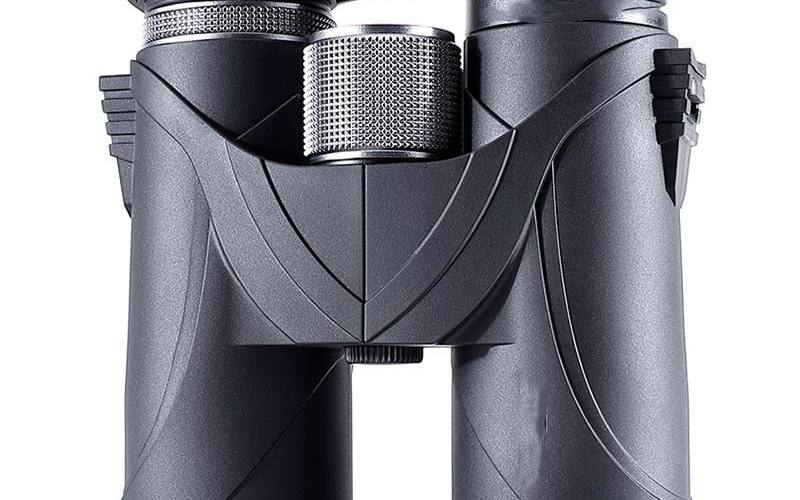
- 8x42 roof prism binoculars: listed with 18 mm of eye relief, above both the Nikon and the RSPB figures. A 5.25 mm exit pupil keeps the view bright in woodland and at dusk.
- 12x50 waterproof binoculars: 16 mm eye relief, twist-up eyecups, a dioptre of plus or minus 3 on the right eyepiece and an IPX7 rating.
The supplier does not give the eye relief for our other models, so we cannot say how they suit glasses. Email us if you want us to check before you order. You can compare all our binoculars, and what the numbers on binoculars mean explains the rest of the specification.
Frequently asked questions
How much eye relief do I need if I wear glasses?
At least 15 to 16 mm. Nikon says binoculars with an eye relief of 15 mm or longer let glasses wearers see the full field of view, and the RSPB advises at least 16 mm for glasses wearers. More is better if your glasses sit far from your eyes.
Should I wear my glasses when using binoculars?
If you are only short-sighted or long-sighted, you can often take them off and let the focus wheel and dioptre make up the difference. If you have significant astigmatism, keep them on: the focus cannot correct astigmatism. You may also prefer to keep them on to save taking them off every time a bird appears.
Why do I see a small circle or black edges with glasses on?
Your eye is too far from the eyepiece for the eye relief of the binoculars. Twist or fold the eyecups fully down so your glasses can sit closer. If you still see black edges, the eye relief is too short for your glasses.
Do your binoculars suit glasses wearers?
Our 8x42 roof prism binoculars are listed with 18 mm of eye relief and our 12x50 waterproof binoculars with 16 mm and twist-up eyecups, so both suit most glasses wearers. The supplier does not give the eye relief of our other models.