Buying guide
Best binoculars for long distance: how far can you really see?
Binoculars for long distance: 10x or 12x, when a tripod helps, 50 mm lenses, heat haze, zoom monoculars and how far the horizon really is.
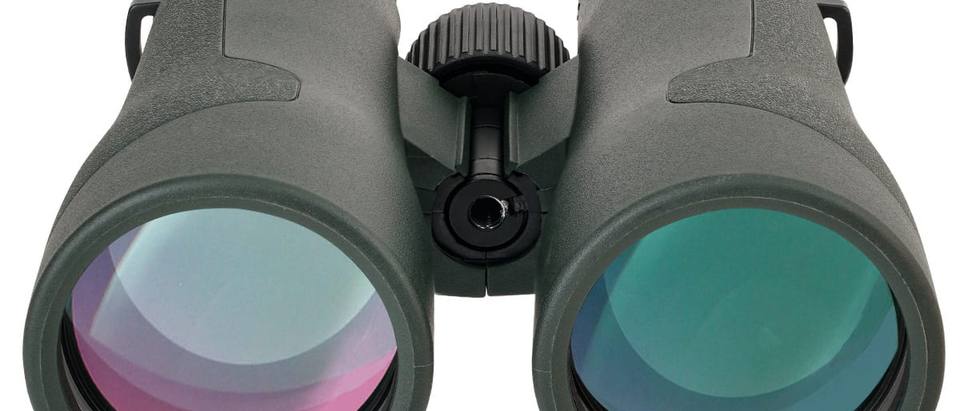
For long-distance viewing, the useful top end for handheld binoculars is 10x to 12x with 50 mm lenses. Beyond about 12x, hand shake, a narrow field and the air itself cancel out most of the extra power unless you use a tripod. And no binoculars can see past the horizon, which is closer than most people think.
What long distance really means
Long distance usually means something between a few hundred metres and a few kilometres away: ships off the coast, seals hauled out on a sandbank, red deer on the far side of a glen, a buzzard circling over the next valley.
Magnification divides the distance. At 12x, a boat 1,200 metres out looks as it would at 100 metres. At 10x, a stag 800 metres away looks as it would at 80 metres. That is a big gain, and for most people it is enough.
How far can you actually see?
On flat ground or at sea, the limit is the curve of the Earth. A widely used approximation gives the distance to the horizon in kilometres as 3.57 times the square root of your eye height in metres. Normal refraction in the atmosphere bends light slightly round the curve, raising the factor to about 3.86.
| Eye height | Horizon (geometric) | With normal refraction |
|---|---|---|
| 1.7 m, standing on a beach | 4.7 km | 5.0 km |
| 10 m, on a sea wall | 11.3 km | 12.2 km |
| 50 m, on a cliff | 25.2 km | 27.3 km |
| 100 m, on a high cliff | 35.7 km | 38.6 km |
| 300 m, on a hill | 61.8 km | 66.9 km |
Tall objects can be seen from further away, because they have a horizon of their own: add the two distances together. Standing on a beach, you could in theory see the top of a 300 m hill about 66 km away (4.7 + 61.8 km), a little further with refraction. Binoculars cannot show anything below that line of sight, whatever their magnification.
In practice the air usually stops you first. The Met Office classes visibility as "good" at 10 to 20 km, "very good" at 20 to 40 km and "excellent" only above 40 km.
Magnification and hand shake
Binoculars magnify the movement of your hands as much as they magnify the view. Nikon recommends magnification up to 12x for comfortable handheld viewing, and says that above 12x hand movement makes viewing uncomfortable unless you use a tripod. The RSPB goes further for wildlife: with anything stronger than 8x or 10x, you would struggle to get a steady view without one.
| Magnification | Handheld? |
|---|---|
| 10x | easy for most adults |
| 12x | fine for short looks, better braced |
| 15x and up | tripod for anything but a glance |
| 20x to 30x (zoom) | tripod or a solid rest, good light only |
On a boat, go lower. Power & Motoryacht says most experts recommend nothing more powerful than 8x for handheld use at sea, because the deck is moving too.
To steady any pair, tuck your elbows into your chest, lean on a wall, a gate or a car roof, and breathe out slowly while you study the detail.
When a tripod helps
For a long session, such as scanning an estuary or waiting for a whale to surface, a tripod turns a shaky 12x view into a calm one. A binocular tripod adapter is a small bracket: one end screws into a threaded socket at the front of the hinge, often under a small cap, and the other fits a standard tripod. Some binoculars, including most compacts, have no socket.
Our 12x50 waterproof binoculars have an adapter thread between the objective lenses. The adapter itself is not included. Our 10x50 and the zoom monocular have no tripod thread listed, so rest them on something solid instead.
Objective size and brightness
The second number is the size of each front lens in millimetres. Nikon explains that, at the same magnification, a larger objective collects more light and gives a brighter image, but makes the binoculars bigger and heavier.
For long views this matters most at dawn and dusk, when the light is low. Divide the lens size by the magnification to get the exit pupil: our 10x50 porro binoculars give 5 mm, the 12x50 gives 4.2 mm. In full daylight both look bright. As the light fades, the 10x50 stays brighter a little longer. What the numbers on binoculars mean explains exit pupil and the other figures in full.
Field of view: what you give up
More magnification means a narrower view. The 12x50 is listed at 88 m at 1,000 m, about 5 degrees, so at 1 km you see a strip 88 metres wide. Finding a small boat on open sea at 12x takes practice.
Find the target with your eyes first, note a landmark beside it, such as a buoy, a headland or a lone tree, then raise the binoculars. Scan slowly in overlapping sweeps rather than waving them about.
Heat haze and the atmosphere
On a warm day distant objects shimmer and refuse to look sharp, however carefully you focus. Celestron explains that air at different temperatures acts like a weak lens that interferes with light from distant objects, especially on hot days, and that early morning is best for high-power viewing because the air temperature is more even. Celestron also notes that paved surfaces and rooftops hold heat and make the effect worse.
What helps:
- Look early in the day, before the ground warms up.
- Avoid looking across roads, car parks and other surfaces that have been in the sun, when you can.
- Turn the power down. Extra magnification enlarges the shimmer along with the detail.
Ordinary haze, mist and drizzle work the same way: binoculars make the scene larger, not clearer.
Zoom binoculars and zoom monoculars
A zoom sounds like the answer: start wide, then zoom in on the detail. Nikon cautions that as the magnification rises, the field of view narrows and the image becomes unstable from hand movement.
Our 10-30x42 zoom monocular shows the trade-off clearly. At 10x the exit pupil is 4.2 mm, at 30x only 1.4 mm, so the view darkens as you zoom in.
- For: one small instrument, 279 g according to the supplier, from a wide view to a close look at a still subject.
- Against: the top of the range needs bright light and a solid rest, and a zoom is a compromise optically.
Use it at the low end most of the time. Monocular vs binoculars compares one eye and two in more detail.
Bigger instruments we do not sell
Some long-distance kit is outside our range. Here is what it involves:
- Large astronomy binoculars such as 20x80 and 25x100. Sky at Night Magazine lists one 20x80 at 2.4 kg and says it needs a substantial tripod or pier; a 25x100 it reviewed weighs 4.6 kg and needed a heavy parallelogram mount.
- Spotting scopes, single-barrel telescopes on a tripod. Celestron says high-power viewing on land works best between 15x and 60x.
- Image-stabilised binoculars, which use electronics to cancel some of the shake at higher power.
If you need 20x and more regularly, one of these is the right tool. For handheld use, a good 10x or 12x pair is the sensible choice.
Which of ours for long distance
| 12x50 | 10x50 porro | 10-30x42 monocular | |
|---|---|---|---|
| Magnification | 12x | 10x | 10x to 30x |
| Exit pupil | 4.2 mm | 5 mm | 4.2 to 1.4 mm |
| Field of view | 88 m at 1,000 m | not listed | not listed |
| Weight (supplier) | 1,046 g | 750 g | 279 g |
| Waterproof | IPX7 | no rating | no rating |
| Tripod thread | yes | not listed | not listed |
Choose the 12x50 for the most reach and wet coastal days, the 10x50 for steadier handheld views and dusk, and the monocular when pocket size matters most. See all our binoculars and monoculars.
Frequently asked questions
What magnification is best for long distance viewing?
For handheld use, 10x to 12x. Nikon recommends magnification up to 12x for comfortable handling, because higher power narrows the view and makes hand movement show. Above that you need a tripod, and on hot days the air itself often limits what extra power can show.
How far can you see with 12x50 binoculars?
Binoculars do not have a range. They make things look closer: at 12x, a boat 1,200 metres away looks as it would at 100 metres. What limits you is the horizon, which is only about 5 km away for an adult standing on a beach, and the clarity of the air.
Are 20x or 30x binoculars better for long distance?
Only on a tripod and in good light. At 20x or 30x every movement of your hands is magnified, the field of view is narrow and the exit pupil is small, so the view is darker. Handheld, a good 10x or 12x usually shows more usable detail.
Do I need a tripod for 12x50 binoculars?
Not for short looks: brace your elbows or rest on a wall or a fence post. For long sessions, such as scanning the sea or a far hillside, a binocular tripod adapter and a tripod give a much calmer view. Check that the binoculars have a thread for the adapter.
Why does the view shimmer on hot days?
Air at different temperatures bends light unevenly and acts like a weak, moving lens. It is worst over warm ground on sunny afternoons. Look in the early morning, when the air is steadier, or turn the magnification down.