Buying advice
Monocular vs binoculars: which should you choose?
Monocular or binoculars? How one eye and two compare for comfort, depth and detail, when a monocular makes sense and what a zoom monocular can and cannot do.
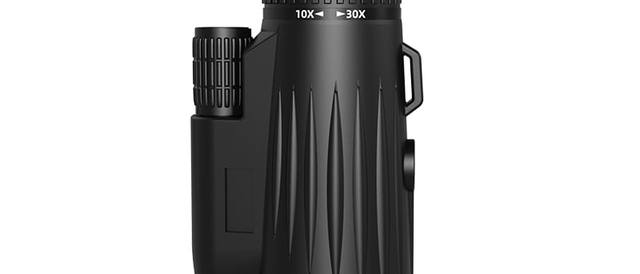
A monocular is, quite literally, half a pair of binoculars: one barrel, one eyepiece, one eye. It is smaller and lighter and works with one hand. Binoculars use both eyes, which changes how comfortable and how detailed the view feels. Neither is better in every situation. This guide compares the two honestly, explains what a zoom monocular can and cannot do, and helps you decide which suits the way you go out.
The short answer
- Choose binoculars if you watch birds or wildlife for more than a few seconds at a time, follow things that move, or look out at dusk.
- Choose a monocular if you want the smallest and lightest option for quick looks on walks and travels, or if you have useful vision in only one eye.
- Consider compact binoculars if you want something pocket-sized but still with two eyes.
Monocular vs binoculars at a glance
| Monocular | Binoculars | |
|---|---|---|
| Eyes used | one | two |
| Sense of depth | none | three-dimensional view |
| Comfort for long looks | tiring, one eye works alone | relaxed, both eyes share the work |
| Size and weight | smallest and lightest | larger and heavier |
| One-handed use | yes | possible, but two hands are steadier |
| Following a moving bird | harder | easier |
| Useful vision in one eye only | a good choice | half of it is wasted |
Why two eyes give a better view
Binoculars do more than double up. The optics maker Pentax says binoculars give a true three-dimensional view with a rich sense of depth, and that they avoid the eye strain that comes from closing or focusing one eye. That matters when you watch a bird for minutes, scan an estuary or follow a raptor across the sky.
Two eyes also see faint detail better than one. Vision scientists call it binocular summation. In a classic 1965 study, Campbell and Green found that one eye needed about 1.4 times more contrast than two eyes to detect the same faint pattern, and a 2018 review of 65 studies in Psychological Bulletin put the average gain at about 1.5. The gain matters most with faint, low-contrast detail, such as a bird in shade or a shape on the water at dusk.
There is also the brain to consider. With one eye you either squint the other shut or ignore what it sees, and both get tiring.
Where a monocular makes sense
A monocular wins on size and convenience. Pentax describes monoculars as lightweight and compact, easy to use with one hand and a strong option for travellers and walkers who want something easy to pack.
Good uses:
- Walking and hiking: checking a waymark, a gate on the far side of a field or a bird on a post.
- Travel: a city view, a boat in a harbour, a carving high on a church.
- Sport and events: a quick look at a scoreboard or a player.
- One good eye: Vision Australia notes that monoculars are particularly suitable if you have useful vision in only one eye. For that person a monocular does the same job and is lighter to carry.
- A spare: a monocular in the glovebox or a coat pocket means you always have something.
Zoom monoculars: what 10-30x really means
Some monoculars, including ours, have a zoom. Turn a ring near the eyepiece and the magnification goes from 10x to 30x. It sounds like three instruments in one, and for some uses it is useful. But higher magnification has a cost.
Nikon explains that higher magnification brings a narrower field of view, an unstable image caused by hand movement, and a smaller exit pupil that makes the image darker, and that zoom models show the same effects as you zoom in. Nikon recommends magnification up to 12x for comfortable handling. The RSPB says that with anything stronger than 8x or 10x you would struggle to get a steady view without a tripod.
The darkening is easy to work out. ZEISS gives the formula: the exit pupil is the lens diameter divided by the magnification.
| Setting on a 42 mm zoom monocular | Exit pupil | What it means |
|---|---|---|
| 10x | 4.2 mm | bright in daylight and into the evening |
| 20x | 2.1 mm | fine in good daylight |
| 30x | 1.4 mm | noticeably darker, best in bright light |
So the honest way to use a zoom monocular is: spend most of your time at the low end, where the view is wider, brighter and steadier, and use the high end for short looks at still subjects with the monocular resting on something solid.
Tips for using a monocular
- Use your dominant eye. Point at something with both eyes open, then close one. If your finger stays on target, the open eye is the one to use.
- Hold it with both hands when you can, even though one is enough. Brace your elbows against your chest.
- Lean on something: a gate, a wall or a tree.
- Focus with the ring or wheel each time the distance changes.
- Cover the other eye with your free hand if squinting it shut becomes tiring.
The middle ground: compact binoculars
If the size of a monocular appeals but you want two eyes, compact binoculars sit in between. They fold to pocket size and still give a three-dimensional view. Our guide to compact vs full-size binoculars covers that choice in detail.
Which should you choose?
| You mostly... | Best choice |
|---|---|
| watch birds in the garden, woods or wetlands | full-size binoculars |
| want something in your pocket on every walk | compact binoculars or a monocular |
| need to check distant, still subjects now and then | a zoom monocular |
| have useful vision in one eye only | a monocular |
| watch at dawn and dusk | full-size binoculars with large lenses |
Our monocular and binoculars
- 10-30x42 zoom monocular: a 42 mm lens, BaK-4 prism and twist-up eyecup, 279 g according to the supplier, with a bag, lanyard and cleaning cloth.
- 10x25 compact binoculars: pocket-sized binoculars with a field of view of 112 m at 1,000 m, about 370 g packed.
- 8x42 roof prism binoculars: a full-size pair with a 5.25 mm exit pupil and 18 mm eye relief, the all-rounder for birdwatching.
You can see every option on our monoculars and binoculars pages. If you choose binoculars, best binocular magnification for bird watching explains whether 8x or 10x suits you.
Frequently asked questions
Is a monocular better than binoculars?
Not for most people. Binoculars are more comfortable for longer looks and give a sense of depth, because you use both eyes. A monocular is better when size, weight and one-handed use matter more than comfort, for example on a long walk or for quick looks at a sign or a boat.
Are monoculars good for birdwatching?
For a quick check of a bird on a walk, yes. For watching birds for minutes at a time, or following them in flight, binoculars are more comfortable and give a sense of depth. A monocular is a good spare to keep in a coat pocket.
Is a 10-30x zoom monocular any good?
It is useful for occasional long views of still subjects, such as a boat, a building or a bird on a post. At the top of the zoom the view is darker and narrower and shakes more, so it is best to use the low end of the zoom most of the time and rest the monocular on something for the high end.
Why does my zoom monocular look darker at 30x?
Because the exit pupil shrinks as the magnification rises. The exit pupil is the objective diameter divided by the magnification, so a 42 mm monocular gives 4.2 mm at 10x but only 1.4 mm at 30x. Less light reaches your eye, and the view looks dimmer, especially in poor light.